本文提出了一种基于机器视觉的西瓜成熟度自动化评估方法,采用 VGG16 预训练模型结合数据增强技术,探索深度学习在农业领域的实际应用。
摘要
随着现在农业现代化的不断推进和消费者对水果质量要求的提升,要如何快速、准确地评估水果的成熟度成为了农业领域的一个重要课题。西瓜作为夏季热门水果,熟度直接影响西瓜的口感。传统的成熟度评估的方法主要依赖人工经验,人工检验的话存在较大的主观性和不一致性,难以满足现在农业生产的需求。
近年来,机器视觉技术的发展为水果成熟度评估提供了新的解决方案。本研究是基于机器视觉中的纹理分析技术,采用卷积神经网络(CNN)和 VGG16 预训练模型,结合了数据增强和正则化方法,探索了一种自动化的西瓜成熟度评估方法。
实验结果表明,尽管模型在小规模数据集上训练,测试集准确率达到了 54.55%,这一结果表明该方法具有一定的可行性,但仍存在较大的提升空间。通过扩充数据集、优化模型结构及引入更多特征,预计能够显著提高评估准确度。本研究为西瓜成熟度评估提供了一种新思路,为农业智能化发展和智能采摘系统的构建奠定了基础。
一、引言
随着农业现代化的发展和消费者对水果质量要求的不断提高,如何快速、准确地评估西瓜等水果的成熟度,成为农业生产中一个亟待解决的关键问题。西瓜作为夏季最受欢迎的水果之一,其成熟度直接关系到果实的口感、糖分含量以及消费者的购买意愿。
- 过早采摘:影响口感和营养价值,降低市场接受度
- 过迟采摘:导致西瓜过熟,产生损耗,影响销售价格
因此,西瓜成熟度的及时准确评估对于农业生产者和商家来说至关重要,能够帮助其在最佳时机进行采摘,提升经济效益。
传统方法的局限性
在传统农业中,西瓜的成熟度评估主要依赖人工经验,通常通过观察西瓜的外观颜色、形状、硬度等指标进行判断。例如,成熟的西瓜往往具有鲜艳的颜色和明显的网纹,底部呈现黄色或白色,且触感富有弹性。
然而,这些方法不仅存在较强的主观性,且对于不同西瓜品种、不同生长环境下的果实,其表现也有所不同,导致了评估结果的不一致性和准确性较低。
机器视觉的兴起
近年来,随着计算机视觉技术和人工智能技术的发展,机器视觉作为一种新型的成熟度评估方法得到了越来越多的关注。机器视觉系统能够通过数字图像采集、图像处理和分析等过程,对西瓜表面的颜色、形状、纹理等特征进行自动化检测,提供一种客观、高效、准确的评估手段。
目前,基于机器视觉的成熟度评估方法主要集中在两个方面:
| 方法 | 原理 | 代表研究 | 局限性 |
|---|---|---|---|
| 颜色分析 | 利用西瓜表面颜色变化推测成熟度,通过 RGB → HSV 颜色空间转换提取颜色特征 | Zhang & Wang(2015)[1] | 受光照和拍摄角度影响大,评估结果不稳定 |
| 纹理分析 | 提取西瓜表面细微纹理特征,使用灰度共生矩阵(GLCM)进行特征提取 | Li & Zhang(2018) | 纹理变化细微,易受品种、气候等因素干扰 |
尽管上述技术取得了一定进展,仍存在以下技术瓶颈:
- 西瓜表面纹理变化通常较为微小,且受品种、气候等因素影响较大
- 光照条件、拍摄角度、图像质量等外部因素会对特征提取产生干扰
- 如何从复杂图像数据中提取稳定且有效的特征,仍是重要挑战
针对这些问题,本研究旨在通过机器视觉中的纹理分析技术,结合深度学习方法,构建一种更为自动化、客观的西瓜成熟度评估模型。
二、实验与结果
2.1 实验设计
为了验证基于机器视觉的西瓜成熟度评估技术的可行性,实验采用了**卷积神经网络(CNN)**并使用 VGG16 预训练模型作为特征提取器,对西瓜图像进行分类。
数据集划分:
| 数据集 | 比例 | 用途 |
|---|---|---|
| 训练集 | 70% | 模型参数学习 |
| 验证集 | 15% | 训练过程中监控泛化能力 |
| 测试集 | 15% | 最终性能评估 |
过拟合应对策略:
由于训练数据集相对较小,模型训练过程中可能出现过拟合现象。为此,采取了以下措施:
- 数据增强:通过旋转、平移、剪切等方式对训练数据进行扩充
- 卷积层冻结:冻结 VGG16 的卷积层,仅训练新添加的全连接层
- L2 正则化:抑制权重过大,提升模型泛化能力
- Dropout 层:随机丢弃神经元,防止过拟合
2.2 结果分析
在模型训练的过程中,验证集的准确率在不断提升,但最终模型的测试集准确率稳定在约 54.55%。
这一结果显示,模型能够在一定程度上判断西瓜的成熟度,但准确率远低于理想水平。主要原因分析如下:
西瓜的成熟度变化呈现细微的差异,这对模型的训练提出了更高的要求。小规模数据集无法充分捕捉到西瓜表面纹理的多样性,导致模型无法学习到更复杂的特征,最终影响了模型的分类效果。
2.3 模型评估
在训练过程中,随着训练集和验证集的迭代,模型的准确率逐渐提高,表明训练过程有效。然而,考虑到当前模型的准确率仅为54.55%,我认为这是由于数据量不足以及西瓜成熟度判断本身的复杂性所导致的。
下图展示了本次训练过程中准确率和损失值的变化曲线:
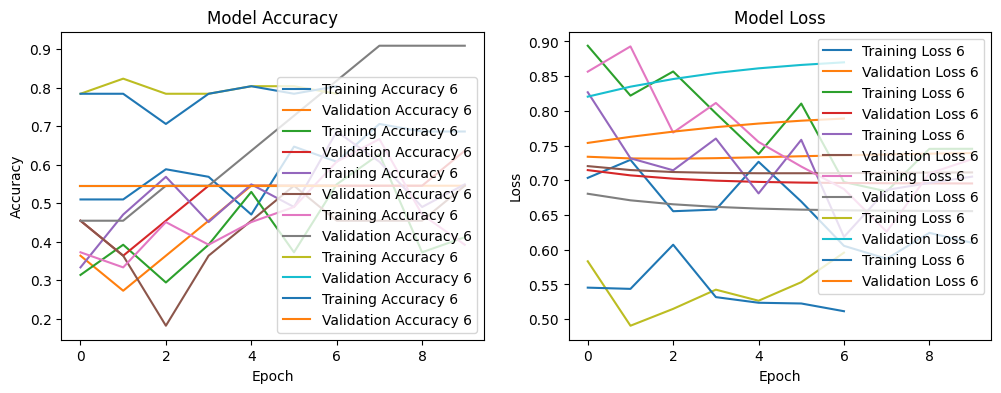
从图中可以看出:
- 训练集准确率持续提升
- 验证集准确率提升速度较慢,且最终有所停滞
这进一步验证了模型在数据量较少时泛化能力受限的问题,也说明扩充数据集是提升模型性能的关键方向。
三、结论
本研究基于机器视觉技术,提出了一种西瓜成熟度的自动化评估方法。通过使用 VGG16 预训练模型并结合数据增强技术,在小规模数据集上训练了一个深度学习模型,并验证了该方法的可行性。
尽管当前模型的测试准确率为 54.55%,该方法仍具有很大的应用潜力,可通过以下途径显著提升模型准确性:
- 📦 扩充数据集:收集更多不同品种、不同光照条件下的西瓜图像
- 🔧 优化模型结构:尝试更先进的预训练模型(如 ResNet、EfficientNet)
- 🧩 引入多模态特征:结合声学检测(敲击音频)等多种感知手段
- 🎯 模型微调:在更大数据集上对预训练模型进行端到端微调
通过本研究,为西瓜的成熟度评估提供了一种新的思路,并为未来农业领域中智能化采摘系统的开发奠定了基础。未来的研究将重点集中在扩大数据集、模型微调以及引入其他先进深度学习技术上,以进一步提高成熟度评估的精确度和应用价值。
参考文献
[1] Zhang, Y., & Wang, J. (2015). Fruit maturity detection based on color analysis using digital images. Journal of Food Engineering, 148, 1–7. https://doi.org/10.1016/j.jfoodeng.2014.10.021
📄 English Version
Abstract
With the continuous advancement of agricultural modernization and the increasing demand for high-quality fruits from consumers, quickly and accurately assessing fruit maturity has become an important issue in the agricultural field. As a popular fruit in summer, watermelon maturity directly affects its taste, nutritional value, and market acceptance. Traditional methods for assessing maturity mainly rely on human experience, which introduces significant subjectivity and inconsistency, making it difficult to meet the needs of modern agricultural production.
In recent years, the development of machine vision technology has provided new solutions for fruit maturity assessment. This study, based on texture analysis techniques in machine vision, employs Convolutional Neural Networks (CNNs) and the pre-trained VGG16 model, combined with data augmentation and regularization methods, to explore an automated method for assessing watermelon maturity. The experimental results show that, despite training the model on a small dataset, the accuracy on the test set reached 54.55%. By expanding the dataset, optimizing the model structure, and introducing more features, it is expected that the assessment accuracy can be significantly improved. This study provides a new approach for watermelon maturity assessment and lays the foundation for the development of agricultural intelligence and smart harvesting systems.
Introduction
With the development of agricultural modernization and the increasing demand for high-quality fruits, how to quickly and accurately assess the maturity of fruits such as watermelon has become a critical issue in agricultural production. Watermelon, one of the most popular fruits in summer, has its maturity directly affecting the taste, sugar content, and consumer purchasing willingness.
Currently, machine vision-based maturity assessment methods mainly focus on two aspects: color analysis and texture analysis. Color analysis generally utilizes the changes in watermelon surface color to infer its maturity. Zhang and Wang (2015) proposed assessing watermelon maturity based on color features by converting RGB to HSV space [1]. However, color analysis is heavily influenced by lighting conditions and shooting angles. Li and Zhang (2018) used the Gray-Level Co-occurrence Matrix (GLCM) to extract watermelon texture features and achieved good results, showing more robustness to lighting variations.
Experiments and Results
1. Experimental Design
To verify the feasibility of the machine vision-based watermelon maturity assessment technology, we used a CNN with the VGG16 pre-trained model as a feature extractor. The dataset was divided into training (70%), validation (15%), and test (15%) sets. Data augmentation techniques such as rotation, translation, and shearing were applied to improve generalization. The convolution layers were frozen, and only the newly added fully connected layers were trained, with L2 regularization and Dropout applied to prevent overfitting.
2. Result Analysis
The final accuracy on the test set stabilized at around 54.55%. The main reason is believed to be the insufficient amount of data, as a small-scale dataset cannot fully capture the diversity of texture features on the watermelon surface.
3. Model Evaluation
The model evaluation metrics include accuracy, loss value, etc. During the training process, with the iteration of the training and validation sets, the model accuracy gradually improved, indicating that the training process was effective. However, considering the current model’s accuracy of only 54.55%, we believe that this is due to insufficient data and the inherent complexity of judging watermelon maturity.
Figure [1] shows the change curves for accuracy and loss during training. As can be seen, the accuracy on the training set keeps increasing, but the improvement on the validation set is slower and eventually stagnates, further confirming the model’s limited generalization ability when the dataset is small.
Conclusion
This study proposes an automated method for assessing watermelon maturity using the VGG16 pre-trained model combined with data augmentation. Although the current test accuracy is 54.55%, the method has significant application potential. By expanding the dataset, optimizing the model structure, and incorporating additional features, the accuracy is expected to improve substantially. This research lays the groundwork for the future development of intelligent harvesting systems in agriculture.
References
[1] Zhang, Y., & Wang, J. (2015). Fruit maturity detection based on color analysis using digital images. Journal of Food Engineering, 148, 1–7. https://doi.org/10.1016/j.jfoodeng.2014.10.021